THE SUBLIME
There are a few moments, hours, and days in
your life when, if you are observant, you may just be in
the presence of the best there's ever been.
It doesn’t matter who was performing, but to give them
credit, it was the quintet, the Canadian Brass. As they
dazzled the audience with the brilliance of their
musicianship and as the melodies and harmonic subtleties
teased my senses, I was caught in a conflicting emotion, a
wistfulness, almost a sadness. That emotion was the sense
of the sublime, and its moment lasted two hours.
I suppose each of us has a different capacity to appreciate
the sublime. It differs from the sentimental, although
maybe the capacity for being affected by one goes with
susceptibility to the other.
For me, the sublime occurs at times like that performance:
the realization that I’m in the presence of the best
there’s ever been, that, no matter how many concerts they
give over a lifetime, what I’m hearing will be heard and
appreciated by only a tiny segment of humanity. Ever. Maybe
from time to time over the next several hundred years other
groups of dazzling brass players will form such groups, but
the audiences then won’t be fortunate enough to hear the
same tunes or witness the same combination of
sophistication and silliness (gold-plated instruments,
tuxedos over white shoelaces) that we were privileged to
see and hear.
The sublime can be ephemeral; either you were there, or you
missed it altogether, forever. Maybe you and I were both
witness to the same event and one of us was spellbound and
the other distracted.
I am overwhelmed by the sublime more often in a museum or
among small groups of people than on the street or in the
wild. And it occurs to me that the wonders of God’s
creation are awe-inspiring and spectacular, but it is the
things done or being done by humans, and sometimes things I
am participating in, which make something sublime. It’s in
the music of Tchaikovsky, both in the fact that it was
composed by a human (and not a deity) in the first place,
then too, as interpreted by virtuoso performers.
The sublime can occur for me in a conversation with a
four-year-old. It’s found in the re-telling of a moment of
heroism – the split second when one person steps forward
and offers a life to save others. It’s found in an
elegantly simple equation in mathematics. It’s found in the
pages of a few great books – those few times when I’ve read
a passage that takes my breath away and I regret that I’m
the lone witness to it at that moment. (I can mark the
passage and show it to someone else later, but the person I
force to read it the next day hasn’t been engrossed in the
whole story as I was. The passage may still have an impact,
but it won’t strike someone else as it did me.)
It occurred when I looked closely at a Fabergé egg in the
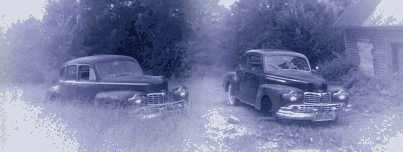
Hermitage; when I passed a Duesenberg on the 17-mile Drive;
when I heard and then saw a steam locomotive working the
Alps; when I’ve watched an Aruban sunset while nibbling a
Havana cigar. It occurs in the moments of scientific
discovery, usually, though, totally unappreciated by the
oblivious, contemporary world and sometimes not even
appreciated by the discoverer. And yet, years or centuries
after such a discovery, I can experience that moment of awe
that the discoverer might or might not have felt too.
A family gathering can be sublime – the balmy afternoon
that passes slowly while all the members are engaged in
leisurely activities and everyone, to a person, is content.
And it is mere contentment that sometimes strikes me as
sublime, as I sit in a quiet room in my house late in the
evening while the rest of the household sleeps, and I
realize the improbability that I have every material
comfort I ever could have wanted, and on top of that the
love of my children and my wife, and in my hand a glass of
Bernkastler Beerenauslese, a substance of sublime qualities
all by itself.
I realize, too, that when something is overwhelmingly
sublime to me, such as the concert of the Canadian Brass,
it may be so only for me. The wistfulness comes when I
wonder whether I am alone in the feeling, and, too, when I
realize that there are people the world over who won’t have
a meal today or a blanket tonight; there are those whose
every waking moment is focused on despotism, murder, pain,
depression, incarceration, fear, hatred, or so many other
distractions; comes too because Maslow understood the
hierarchy of needs all too well, that those dominated by
such distractions may never know the sensation I am
describing.
I’m not especially alert for it. It happens of its own
accord. I can’t will it to infuse an event, even if I think
all the elements are there. It is something, as I say, to
which I am, as I suspect all humans are to a degree,
susceptible.
There are times when I am knocked flat by my own
unworthiness. There are lines in a couple of standard
church hymns, for instance, that I cannot sing, and indeed
one entire hymn, known to almost everyone, that takes away
my voice, so powerfully does it humble me. This is
something beyond the sublime, but what it is I cannot name.
A line in the hymn ‘It Came Upon A Midnight Clear’
concludes: “O hush the noise, ye men of strife, and hear
the angels sing.” Hearing angels sing would exceed the
sublime – would cross into the divine – but the exhortation
can be adapted, (and I would not presume to improve upon
the original line, which in itself is another example of
what I’m talking about): “O hush the noise, and in the
pause, attend for the sublime.”
2002
©DamnYankee.com